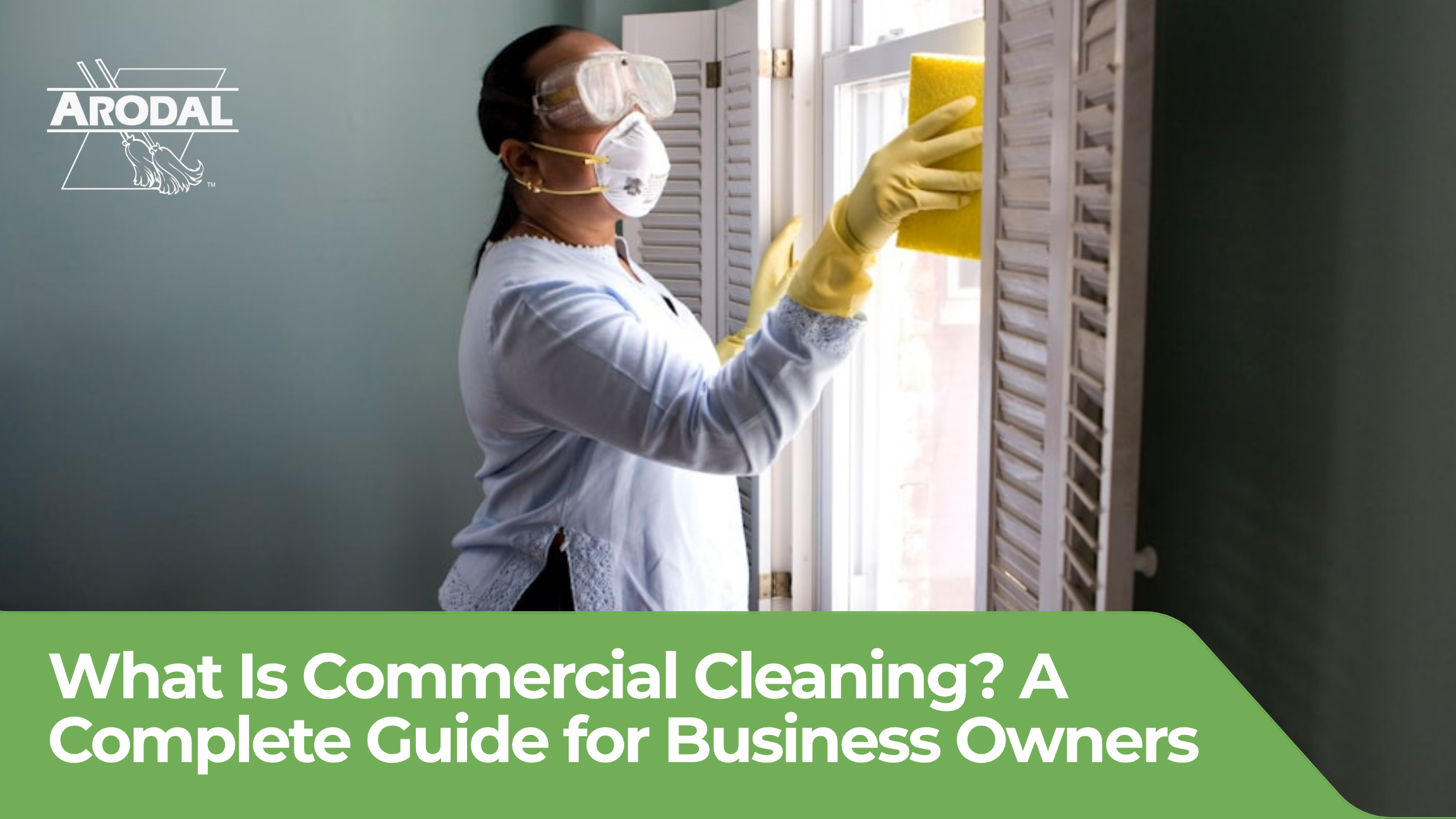
Commercial cleaning is professional cleaning performed in business and public-use spaces like offices, medical facilities, retail stores, schools, warehouses, and more. It’s not the same as hiring someone to clean your home. The scope, frequency, and compliance requirements are different. And for Washington State business owners, getting it wrong carries real consequences: failed health inspections, higher employee sick rates, and facilities that tell clients the wrong story before you’ve said a word.
This guide covers what commercial cleaning includes, which industries need it most, how often to schedule it, what it costs in Washington, and how to choose the right vendor.
Key Takeaways
- Commercial cleaning covers professional services for non-residential spaces, from routine janitorial work to specialty services like carpet extraction and post-construction cleanup
- Different industries, including medical offices, restaurants, warehouses, and schools, have different compliance standards and service requirements
- Cleaning frequency depends on four variables: business type, square footage, daily foot traffic, and regulatory requirements
- In Washington State, commercial cleaning costs typically range from $0.05 to $0.25 per square foot, depending on service type and frequency
- The right vendor brings documented processes, verifiable credentials, and a service agreement that protects your business, not just a low quote
What Is Commercial Cleaning?
Commercial cleaning refers to professional cleaning services delivered in non-residential facilities. It covers business properties, healthcare buildings, schools, retail environments, industrial sites, and any space open to employees, customers, or the public.
The scope goes well beyond routine home cleaning. Commercial cleaning can be daily, weekly, monthly, seasonal, or one-time. It may include standard janitorial maintenance (trash removal, restroom sanitation, floor care) as well as specialty services like carpet extraction, hard floor strip-and-wax, window cleaning, and post-construction cleanup.
The function it serves is broader than aesthetics. Commercial cleaning supports hygiene and infection control, protects flooring and surfaces from premature wear, reduces liability exposure, and keeps facilities compliant with state and federal standards that apply to Washington businesses.
Types of Commercial Cleaning Services
Janitorial Cleaning Services
Janitorial cleaning is routine, recurring maintenance for commercial facilities. It keeps a building operational day to day. Typical tasks include removing trash and replacing bin liners, sanitizing restrooms and restocking paper products, vacuuming carpeted areas and mopping hard floors, wiping down surfaces and common areas, and servicing entrance mats.
Frequency depends on the facility. High-traffic offices with 500 or more employees or visitors per day generally require nightly service. Smaller professional suites under 5,000 sq ft can often maintain standards with 2 to 3 visits per week.
Window Cleaning Services
Commercial window cleaning removes grime, streaks, and mineral deposits from interior and exterior glass. Services cover storefront and lobby glass panels, interior partition and conference room glass, water spots and mineral deposits on exterior windows, and upper-floor exterior glass via rope or lift-assisted access.
One compliance point Washington facility managers often miss: exterior window cleaning at height must comply with WISHA — Washington Industrial Safety and Health Act — fall protection standards. Always verify a vendor’s compliance documentation before signing.
Storefronts and lobbies typically need monthly service. Upper floors are usually adequate on a quarterly schedule.
Carpet and Upholstery Cleaning Services
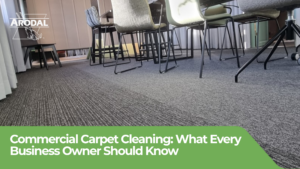
Commercial carpet and upholstery cleaning removes embedded dirt, allergens, and stains from carpeted floors and fabric furniture. Hot water extraction (HWE) is the standard for deep cleaning. Encapsulation is used for interim maintenance between full extractions. Technicians also perform spot and stain treatment for high-traffic zones and upholstery cleaning for chairs, sofas, and cubicle panels.
The industry benchmark for this work is IICRC certification — Institute of Inspection Cleaning and Restoration Certification. Ask any vendor whether their technicians hold it before hiring.
Most commercial facilities need full extraction every 6 to 12 months, with quarterly service for high-traffic lobbies, break rooms, or customer-facing areas.
Hard Floor Scrubbing and Waxing Services
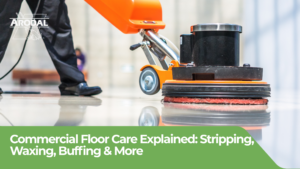
Hard floor scrubbing and waxing restores the appearance and protective finish on vinyl, concrete, and tile commercial flooring. The process runs in four steps: strip old wax layers using a floor machine and chemical stripper, scrub the surface to remove embedded grime, apply 2 to 4 fresh coats of commercial floor finish, and burnish to a high-gloss shine.
A full strip and wax is typically needed every 6 to 12 months depending on traffic volume. Interim buffing or burnishing every 4 to 8 weeks maintains the finish between full cycles.
Post-Construction Cleanup Services
Post-construction cleaning removes debris, dust, and construction residue from a commercial facility before occupancy. It runs in three phases. The rough clean removes large debris, including drywall scraps and construction materials, from the work area. The final clean detail-cleans all surfaces, fixtures, windows, floors, and restrooms to a move-in standard. The touch-up phase is a final walkthrough to correct any missed areas before client handover.
Common Industries That Need Commercial Cleaning in Washington State
Nearly every commercial business in Washington State requires professional cleaning. Scope, frequency, and protocols vary by industry.
Offices and Corporate Buildings
Offices and corporate buildings require daily or nightly janitorial services to maintain hygiene across high-traffic shared spaces. Core needs include nightly janitorial, quarterly carpet extraction, periodic floor stripping and waxing, and restroom deep cleaning.
Medical and Dental Offices
Medical and dental offices require hospital-grade disinfection and infection control protocols that exceed standard janitorial service. Vendors working in these environments must follow CDC Environmental Infection Control Guidelines, OSHA Bloodborne Pathogen Standard (29 CFR 1910.1030), and Washington DOH facility cleanliness standards. Standard commercial cleaning companies are not equipped for this work. It requires documented training and compliant products.
Retail Stores and Shopping Centers
Retail stores and shopping centers require daily cleaning to maintain safe, presentable conditions for high customer foot traffic. Entrance mat service, daily hard floor maintenance, restroom sanitation, and storefront window cleaning are the standard service mix.
Restaurants and Food-Service Businesses
Restaurants and food-service businesses must maintain cleaning standards that support Washington State Department of Health (DOH) inspection requirements. Core services include dining area sanitization, restroom service, hard floor scrubbing, and high-touch surface disinfection. Lapses here are not just aesthetic. They show up in inspections.
Warehouses and Industrial Facilities
Warehouses and industrial facilities require heavy-duty floor scrubbing, dust control, and break room sanitation on a scheduled basis. Concrete floor scrubbing, loading dock cleaning, dust control, and periodic deep cleaning of break rooms and restrooms form the standard scope.
Schools, Daycares, and Educational Facilities
Schools, daycares, and educational facilities require frequent disinfection of high-touch surfaces and shared restrooms to reduce illness transmission. During school term, daily cleaning is standard. Deep cleaning during breaks addresses what routine service cannot reach.
Why Washington Businesses Need Commercial Cleaning Services
A professionally cleaned facility protects more than its appearance. Six outcomes drive the business case:
Employee health and reduced germ spread. High-touch surfaces, including door handles, elevator buttons, and shared equipment, are the primary vectors for illness transmission in commercial buildings. Routine disinfection reduces sick days and the productivity losses that follow.
Better first impressions for customers and clients. Clients form opinions about your business before they sit down. A clean lobby, spotless restrooms, and maintained floors communicate professionalism. The reverse is equally true.
Improved productivity and morale. Research consistently shows cleaner workplaces support better focus and higher employee satisfaction. Clutter and visible grime are low-level stressors that accumulate.
Longer lifespan for flooring, carpets, furniture, and fixtures. Dirt is abrasive. Embedded grit degrades carpet fibers and scratches hard floors. Regular maintenance extends asset life and defers capital replacement costs.
Safer facilities for employees, tenants, and visitors. Clean floors reduce slip-and-fall risk. Proper waste disposal and restroom sanitation reduce exposure to hazardous materials.
Better readiness for inspections, leases, and public-facing operations. Health inspections, facility audits, and lease renewals all involve facility condition. A consistently maintained building does not scramble before inspections. It is already ready.
How Often Should a Business Schedule Commercial Cleaning?
Cleaning frequency depends on four variables: business type, square footage, daily foot traffic, and industry compliance requirements.
| Facility Type | Recommended Frequency |
|---|---|
| Corporate office, 10,000+ sq ft | Nightly janitorial |
| Small professional suite, under 5,000 sq ft | 2 to 3x per week |
| Medical or dental office | Daily; infection control protocols required |
| Retail store or shopping center | Daily |
| Restaurant or food service | Daily; DOH compliance standards apply |
| School or daycare (in session) | Daily; deep clean during breaks |
| Warehouse or industrial facility | Weekly or bi-weekly; periodic deep clean |
| Post-construction | One-time; 3-phase process |
These are starting-point benchmarks. A pediatric dental clinic in a high-traffic Seattle strip mall has different requirements than a two-person professional office in Tacoma. Your actual schedule should reflect your facility’s specific risk profile and any applicable compliance standards.
How Much Does Commercial Cleaning Cost in Washington State?
Commercial cleaning in Washington State is typically priced per square foot, per hour, or as a flat monthly rate. For most commercial facilities, the practical range runs from $0.05 to $0.25 per square foot depending on service type and frequency.
Janitorial cleaning for a standard office generally runs $0.05 to $0.12 per square foot per visit. Carpet extraction typically costs $0.15 to $0.35 per square foot. Hard floor strip and wax services generally run $0.20 to $0.45 per square foot. Post-construction cleanup is often quoted as a project rate and varies significantly by scope and debris volume.
Three factors push costs higher in Washington. The state’s minimum wage is currently $16.28 per hour as of January 2025, per the Washington State Department of Labor and Industries. Labor-intensive specialty services and compliance requirements for regulated environments like medical offices and food service add further to that baseline.
One thing to watch: the cheapest bid rarely reflects the actual cost of a compliant, consistent service. Low-bid vendors frequently cut corners on product quality, worker pay, or supervision. All of which show up in service quality within 90 days.
How to Choose the Right Commercial Cleaning Service in Washington State?
Five questions separate qualified vendors from ones who will cost you more in the long run.
Are they licensed, bonded, and insured in Washington State? This is non-negotiable. Verify their business license, general liability coverage, and workers’ compensation documentation before signing anything.
What does their service agreement look like? Short-notice cancellation policies, defined scope of work, and escalation procedures for missed services should all be in writing. Vendors without clear agreements expose you to disputes over what is included.
Do they have documented quality control? Ask how they verify completed work. Real-time manager access and supervisor walkthroughs are strong indicators. Vendors who cannot describe their QC process do not have one.
Do they use compliant products for your facility type? Medical environments require EPA-registered hospital-grade disinfectants. Green cleaning options, including Green Seal certified products, are increasingly standard for offices prioritizing sustainability and indoor air quality.
Can they provide local references? A vendor with 10 years in Seattle’s commercial market should be able to name current clients in similar industries. A vendor who cannot, will not.
Experience matters in this industry more than most buyers realize. Companies with long-tenure staff, including cleaners who have been on the same accounts for 10, 15, even 20 years, deliver materially more consistent results than operations with high turnover. Institutional knowledge of a building does not transfer when a new crew shows up every few months.
Conclusion
Commercial cleaning is a professional service with real compliance requirements, industry-specific protocols, and measurable consequences when done poorly. For Washington State business owners, the decision is not whether you need it. Nearly every commercial facility does. The decision is whether your current vendor or service schedule actually matches what your facility requires.
A 50-person office with daily client visits has different needs than a weekend-use church hall. A pediatric dental clinic has different needs than a retail storefront. Getting the scope, frequency, and product standards right is what separates a facility that consistently performs from one that chronically underperforms.
If you are ready to move from guesswork to a documented cleaning plan built for your specific facility, get in touch with Arodal for a free cleaning quote.
Frequently Asked Questions
What is commercial cleaning?
Commercial cleaning is professional cleaning performed in non-residential business and public-use spaces, including offices, medical facilities, schools, retail stores, restaurants, and industrial buildings. It covers routine janitorial maintenance and specialty services like carpet extraction, window cleaning, and floor care.
What does commercial cleaning include?
Commercial cleaning includes janitorial services (trash removal, restroom sanitation, vacuuming, mopping, surface wiping), window cleaning, carpet and upholstery cleaning, hard floor scrubbing and waxing, and post-construction cleanup. Scope varies by facility type and service agreement.
What is the difference between janitorial and commercial cleaning?
Janitorial cleaning is a subset of commercial cleaning. It refers specifically to routine, recurring maintenance like nightly trash, restroom service, and floor care. Commercial cleaning is the broader category that includes specialty services like carpet extraction, floor refinishing, and post-construction cleanup.
Is commercial cleaning taxable in Washington State?
Yes. According to the Washington State Department of Revenue, commercial janitorial and cleaning services are generally subject to the Business and Occupation (B&O) tax. Consult a Washington State tax professional for guidance specific to your business situation.
How often should an office be professionally cleaned?
Most offices with regular employee presence benefit from nightly or 2 to 3x per week janitorial service. Larger offices with 500 or more daily occupants typically require nightly service. Smaller suites under 5,000 sq ft can often maintain standards with 2 to 3 visits per week.
How much does commercial cleaning cost in Washington?
Commercial cleaning in Washington State typically runs $0.05 to $0.25 per square foot depending on service type and frequency. Hourly rates for general janitorial work generally range from $25 to $45 per hour. Specialty services like carpet extraction or floor strip-and-wax are priced separately.
Do commercial cleaners bring their own supplies?
Most professional commercial cleaning companies supply their own equipment and cleaning products. Confirm this in your service agreement, and ask about the specific products used, particularly if your facility requires Green Seal certified, hospital-grade, or food-safe cleaning products.
What should I ask before hiring a commercial cleaning company?
Ask about their Washington State business license, liability insurance, workers’ compensation coverage, quality control process, product certifications, cancellation policy, and local references. Ask specifically how they handle missed services and how quickly a real person responds to issues.
Do medical offices need special commercial cleaning?
Yes. Medical and dental offices require hospital-grade disinfection and infection control protocols that meet CDC Environmental Infection Control Guidelines, OSHA Bloodborne Pathogen Standard (29 CFR 1910.1030), and Washington DOH facility standards. Standard janitorial vendors are not equipped for this work.
Is green commercial cleaning available in Washington?
Yes. Green cleaning options using Green Seal certified products are available from qualified commercial cleaning providers throughout Washington State. These products meet rigorous environmental and safety standards and are appropriate for offices, schools, and facilities where indoor air quality is a priority.